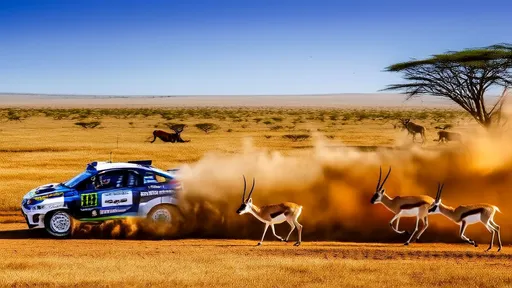
The WRC Safari Rally Kenya is unlike any other event in the World Rally Championship calendar. Where else can you find high-speed rally cars tearing through rugged terrain while elephants, giraffes, and lions roam nearby? This is motorsport at its most untamed—a thrilling collision of man, machine, and nature that pushes drivers to their limits while demanding respect for the wild landscapes they invade.
Held in the savannahs surrounding Naivasha, the Kenyan round of the WRC is a throwback to rallying’s golden age, when endurance mattered as much as outright speed. The stages are unforgiving: deep fesh-fesh dust that chokes engines, jagged rocks lurking beneath deceptively smooth surfaces, and sudden rainstorms that turn dry riverbeds into impassable bogs. But the real wildcard? The animals. Unlike controlled racing circuits, here, the local wildlife has right of way. Drivers must stay alert for unexpected crossings—sometimes with only seconds to react.
The 2024 edition delivered drama from the very first stage. Championship leader Kalle Rovanperä nearly clipped a wandering warthog during the Loldia Shakedown, while Thierry Neuville’s Hyundai i20 N Rally1 kicked up a dust cloud so thick it temporarily obscured a grazing zebra herd. "You see movement in the bushes and your instincts take over," admitted Toyota’s Takamoto Katsuta. "Brake first, ask questions later. No trophy is worth harming these creatures."
This delicate balance between competition and conservation defines the event. Rally organizers work closely with Kenya Wildlife Service, deploying spotters along stages and adjusting routes if endangered species are nearby. Spectators, too, receive strict briefings: no honking, no littering, and absolutely no attempts to feed baboons (a lesson learned after a mischievous troop stole a mechanic’s lunch mid-service in 2022). The partnership has paid off—since the rally’s WRC return in 2021, not a single animal incident has been recorded.
Yet the wilderness remains an active participant. On Friday’s Soysambu stage, Ott Tänak lost two minutes when his Ford Puma became stuck behind a bull elephant nonchalantly blocking the track. Rather than risk honking, the Estonian waited patiently as rangers gently redirected the 6-ton mammal. "I’ve had mechanical failures before," Tänak quipped, "but this was my first ‘biological retirement.’" Meanwhile, Adrien Fourmaux swerved to avoid a dik-dik antelope, sending his car into a spectacular barrel roll—miraculously, both driver and animal emerged unharmed.
The terrain itself tells a story millions of years in the making. The Hell’s Gate stage runs through a volcanic rift where geothermal steam vents hiss beside the racing line, while the Elementaita route skirts lakes pink with flamingos. "It’s humbling," said nine-time champion Sébastien Loeb during his guest appearance. "In Europe, we race past hay bales and spectators. Here, it’s acacia trees and termite mounds taller than our cars. Mother Nature reminds you who’s really in charge."
Local knowledge proves invaluable. Kenyan drivers like Carl "Flash" Tundo dominate the WRC2 category here, their experience reading unpredictable surfaces giving them an edge over factory teams. "You don’t attack these roads," explained Tundo after winning the WRC2 division. "You dance with them. The moment you force things, the fesh-fesh swallows you whole." His advice? "Trust the elephants—they always pick the firmest ground."
By Sunday’s final Power Stage, only the resilient remained. A dehydrated Pierre-Louis Loubet battled heatstroke after his aircon failed in the 38°C equatorial sun, while Gus Greensmith’s suspension collapsed in a hidden erosion trench. But the cruelest twist came for Elfyn Evans: leading by 18 seconds, his Toyota hit a submerged rock in the Malewa stage, gifting Neuville a victory even the Belgian called "75% luck." As the champagne sprayed over Naivasha’s dusty podium, marabou storks circled overhead—nature’s unofficial race marshals observing another chaotic chapter in this most primal of rallies.
What makes Safari Rally Kenya special isn’t just the challenges, but how they transform competitors. "Back in Estonia, we complain about potholes," laughed Tänak. "Here, a ‘pothole’ might be a hippo wallow." The event strips away modern rallying’s technological crutches, rewarding adaptability over aerodynamics. As WRC CEO Jona Siebel noted: "This is the last truly wild rally. You can’t simulate fesh-fesh in a wind tunnel or code wildlife alerts into a pace note app."
For 2025, organizers plan to extend stages deeper into Maasai lands, incorporating river crossings where crocodile sightings are common. But one tradition remains unchanged: the pre-rally blessing by Maasai elders, who sprinkle milk over competing cars—a ritual that, perhaps, explains why no major animal encounters have turned fatal. In a sport increasingly dominated by hybrid engines and computer simulations, Kenya stands as a visceral reminder of rallying’s adventurous soul. As the sun set over the Great Rift Valley, a lone lion’s roar echoed across the savannah—the original predator acknowledging its noisy, fuel-injected rivals.
By /Jun 14, 2025
By /Jun 14, 2025
By /Jun 14, 2025
By /Jun 14, 2025
By /Jun 14, 2025
By /Jun 14, 2025
By /Jun 14, 2025
By /Jun 14, 2025
By /Jun 14, 2025
By /Jun 14, 2025
By /Jun 14, 2025
By /Jun 14, 2025
By /Jun 14, 2025
By /Jun 14, 2025
By /Jun 14, 2025
By /Jun 14, 2025
By /Jun 14, 2025
